




LAW & COMPLIANCE · SWITZERLAND · 2026
Switzerland’s Beneficial Ownership Register and New Anti-Money Laundering Law 2026: The Complete Guide for Companies and Advisors
Switzerland is making a regulatory paradigm shift. With the new Transparency Act (TJPG) and the revised Anti-Money Laundering Act (AMLA / GwG), the country is creating its first central, federal beneficial ownership register for the ultimate beneficial owners of companies. Both enactments enter into force on October 1, 2026. For public limited companies (AG), limited liability companies (GmbH), foundations, associations, and many other legal entities, this means new identification and reporting obligations, tight deadlines, and significant sanctions for violations.
This guide explains in plain terms what is changing, who is affected, which deadlines apply, and how companies and advisors should prepare now.
Key Takeaways
- Entry into force: October 1, 2026 (Federal Council decision of June 12, 2026).
- Two enactments: the revised Anti-Money Laundering Act (AMLA / GwG) and the new Transparency Act (TJPG).
- Centerpiece: a central, non-public federal register of beneficial owners.
- Who must report: Swiss capital companies (above all the AG and the GmbH), cooperatives, foundations, certain associations, and specific foreign legal entities with a connection to Switzerland.
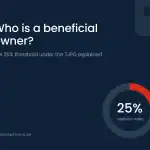
- Threshold: a person is generally a beneficial owner if they hold 25% or more, or exercise comparable control.
- Sanction: an intentional breach can be punished with a fine of up to CHF 500,000.
- New for advisors, too: attorneys and notaries become subject to the AMLA for certain structuring activities.
Why is Switzerland introducing a transparency register?
The reform is driven by the international standards of the Financial Action Task Force (FATF), in particular Recommendation 24 on the transparency of legal persons. Until now, transparency about beneficial owners in Switzerland was established mainly on an ad hoc basis by financial intermediaries (banks, asset managers), within individual business relationships.
The reform turns this into a structural corporate-law obligation: every affected legal entity must itself identify, verify, and report its ownership and control structures to a central register. The goal is to make it harder to use opaque structures that conceal money laundering, terrorist financing, organized crime, and sanctions evasion.
A practical side effect for the financial center: credible implementation strengthens Switzerland’s standing in international comparison. The effectiveness of these measures is expected to be assessed in the next FATF country review in 2027–2028.
Two laws, one goal: the TJPG and the AMLA revision
The reform consists of two interlocking but legally independent enactments.
The Transparency Act (TJPG)
The Federal Act on the Transparency of Legal Entities and the Identification of Beneficial Owners creates the transparency register and the associated identification and reporting obligations. The party bound by these obligations is the legal entity itself, represented by its governing bodies.
The revision of the Anti-Money Laundering Act (AMLA)
In parallel, the Anti-Money Laundering Act is being revised. The key change: certain advisory activities now become subject to the AMLA. As a result, anti-money-laundering due diligence obligations will also apply to attorneys and notaries when they engage in structuring activities.
Important: the TJPG does not in itself make advisors subject to the AMLA. A two-tier system emerges: primary responsibility for accurate register reporting lies with the company, while those subject to the AMLA must fulfill their own due diligence obligations independently.
Who must report? Scope of the transparency register
The register covers, in particular:
- Swiss capital companies, above all the public limited company (AG) and the limited liability company (GmbH);
- cooperatives;
- foundations and certain associations;
- investment companies;
- foreign legal entities whose effective management is located in Switzerland or that own real estate in Switzerland;
- trustees domiciled or resident in Switzerland.
Including foreign structures with a management or real-estate connection to Switzerland is meant to prevent circumvention through offshore or shell constructions.
Who is exempt?
The scope does not cover, among others:
- companies listed on a stock exchange, as well as their subsidiaries (where there are at least 75% capital or voting rights);
- occupational pension institutions (pension funds);
- legal entities held by public bodies.
For sole proprietorships, essentially nothing changes, since comparable concealment through chains of ownership is not possible there.
Who qualifies as a “beneficial owner”?
The concept of the beneficial owner (ultimate beneficial owner, UBO) follows the definition already familiar from the AMLA. A beneficial owner is the natural person who ultimately controls a company or is entitled to it. The decisive factors are typically:
- a holding of 25% or more of the capital or voting rights, or
- a comparable means of control by other means (e.g., voting agreements, veto rights, or other decisive influence).
What matters is not the formal, civil-law intermediate level in a chain of ownership, but the actual control at the end of the chain. If no such person can be identified, a subsidiary rule applies: the most senior members of the managing body (e.g., the board of directors or management) must then be reported.
What information must be reported?
For each beneficial owner, at minimum the following must be recorded: full first and last name, date of birth, nationality, place of residence, and the nature and extent of control or influence in the company. This information must be documented, kept up to date on an ongoing basis, and accessible in Switzerland at all times. The retention period is ten years.
“Know Your Owner”: more than just a self-declaration
The obligation is not satisfied by merely accepting a self-declaration from the shareholders. Appropriate inquiries and plausibility checks are required, in effect a “know-your-owner” principle. Companies must obtain suitable supporting evidence, such as proof of holdings or contracts.
If a beneficial owner cannot be identified, or their control cannot be satisfactorily verified, the steps taken must be documented. Transparency about ownership and control structures thus becomes part of corporate-law compliance and falls within the responsibility of the governing bodies.
Deadlines: when must you report?
Some of the deadlines are very short. Beginning with entry into force on October 1, 2026, the transitional periods for existing companies start to run.
| Situation | Reporting deadline to the register |
|---|---|
| New company (after entry in the commercial register) | within 1 month of registration |
| Foreign legal entity (after becoming subject to the TJPG) | within 1 month |
| Change to registered facts | within 1 month (electronic platform) |
| Existing company with all UBOs already in the commercial register | 2 years (Art. 51 para. 2 TJPG) |
| Existing company (general rule) | 1 month after the first register change post-entry |
Changes in holdings only need to be reported if they cause a threshold to be crossed in either direction (e.g., crossing the 25% mark).
Practical tip: even companies whose beneficial owners are fully recorded in the commercial register should not let the two-year period lapse passively. As soon as a commercial-register change occurs, the deadline shortens to one month.
Sanctions: what are the consequences of violations?
The sanction risks are considerable. An intentional breach of the identification and reporting obligations can be punished with a fine of up to CHF 500,000. Administrative measures are also possible.
Particularly relevant for those in charge: the transparency obligations become part of the general organizational and supervisory duties of the governing bodies. If the board of directors, management, or foundation board fail to maintain adequate internal controls, or do not update register entries on time, personal liability may come into play.
A note on the burden of proof: Parliament expressly rejected a statutory presumption of accuracy for register entries. In practice, a complete and correct entry is nonetheless likely to have a de facto exonerating effect.
Who can access the register? Not a public register
Unlike in parts of the EU, the Swiss transparency register is not public. It is maintained by the federal administration (Federal Department of Justice and Police) and is accessible only to certain authorities and, under defined conditions, to financial intermediaries.
Financial intermediaries, however, may not rely blindly on the register’s data. They must continue to fulfill their own due diligence obligations under the AMLA and verify the information themselves. If a financial intermediary detects a discrepancy that raises doubts about the accuracy, completeness, or timeliness of the data, it must report that discrepancy to the register within 30 days.
Now in focus: attorneys and notaries as parties subject to the AMLA
One of the most-discussed changes concerns advisory professions. Attorneys and notaries will become subject to anti-money-laundering due diligence obligations when they carry out structuring activities on a professional basis, for example when they:
- design or structure corporate or asset structures;
- enable the formation or administration of legal entities;
- assume governing-body, fiduciary, or nominee functions;
- provide a domicile or registered office;
- or carry out an activity objectively capable of making it harder to identify beneficial owners.
Activity-based, not status-based
The decisive point: the subjection is activity-based, not status-based. Pure legal advice, forensic work, and representation in proceedings remain privileged under professional secrecy. Only when an attorney functionally assumes a role economically comparable to that of a financial intermediary does the subjection apply.
Once the subjection applies, the classic due diligence obligations come into play: identifying the contracting party, establishing the beneficial owner, conducting a risk analysis, documentation, and, where applicable, filing a report with the Money Laundering Reporting Office Switzerland (MROS). A tension therefore remains between anti-money-laundering prevention and attorney-client privilege, the practical handling of which will only become clear in enforcement and case law.
What companies should do now: the preparation checklist
The transition window until October 2026 is short, especially for holding structures, international ownership chains, and domicile companies. The following steps help with preparation:
- Work through ownership relationships: fully map ownership and control structures, down to the actually controlling natural person.
- Identify beneficial owners: also examine alternative forms of control (e.g., veto rights, voting agreements).
- Obtain and document supporting evidence: proof of holdings, shareholder agreements, fiduciary arrangements.
- Assign responsibilities: who is accountable for collection, reporting, and updating?
- Set up processes and deadline monitoring: establish internal workflows for initial and change reports.
- Adapt governance and compliance systems: implement internal policies and train those responsible.
- Ensure retention: keep documentation accessible in Switzerland at all times for ten years.
What advisors should additionally keep in mind
Attorneys and notaries should systematically classify their engagements: is this purely advisory work, or is there structuring, administrative, or organizational involvement? A clean internal classification and documentation of activities becomes the decisive compliance element, especially in borderline cases.
Frequently asked questions (FAQ)
When do the new Anti-Money Laundering Act and the transparency register enter into force?
Both enactments — the revised AMLA and the new TJPG — enter into force on October 1, 2026. The Federal Council made this decision on June 12, 2026. An exception applies to provisions on official notariats, for which the cantons still have to adapt their own laws.
Is the Swiss transparency register publicly accessible?
No. It is a central, non-public federal register. Access is limited to certain authorities and, under defined conditions, financial intermediaries.
At what level of holding does someone qualify as a beneficial owner?
Generally from a holding of 25% of the capital or voting rights — or where there is a comparable means of control by other means.
What penalty applies for a missing or incorrect report?
An intentional breach of the identification and reporting obligations can be punished with a fine of up to CHF 500,000. In addition, administrative measures and personal liability of the governing bodies may come into play.
Do associations and foundations also have to report?
Foundations and certain associations fall within the scope. Whether a specific association is covered depends on how this is set out in the act and ordinance — when in doubt, a legal assessment is advisable.
What applies to listed companies?
Companies listed on a stock exchange and their subsidiaries (from 75% capital or voting rights) are exempt from the scope.
Do banks have to rely on the register?
No. Financial intermediaries retain their own due diligence obligations under the AMLA and must verify the information themselves. Discrepancies must be reported within 30 days.
Conclusion
With the Transparency Act (TJPG) and the parallel AMLA revision, Switzerland is making a regulatory paradigm shift: transparency about beneficial owners moves from an ad hoc verification task to a structural obligation of every affected company, and anti-money-laundering prevention now also captures structuring advisory activities.
For companies, boards of directors, and advisory professions, this means significantly greater regulatory responsibility — under tight deadlines and with tangible sanction risks. Those who use the time until October 1, 2026, to examine their structures, set up processes, and clarify responsibilities will have a clear advantage.
This article is for general information only and does not constitute legal advice. For an assessment of your specific situation, consulting a qualified professional is recommended.


